blog/Design

Stamen’s Dark (Map) Materials

We’ve made a lot of dark maps over the years at Stamen. We’ll often see dark maps from other designers or commercial providers and think, “why so dark?” We have a philosophy around designing a dark map for a particular client or use case, but we haven’t ever really spelled it out – either internally...

What We Map in the Shadows

Dark greetings! We’ve been thinking a lot about dark maps in recent months (as Kelsey presented about recently at NACIS) and the thought occurred to us: how quickly could we make a nice dark mode version of Stamen’s iconic Toner style?  As you may recall, a couple years ago we created vectorized versions of our...

Brain Cartography: Mapping a place that everyone knows, but (almost) no one has ever been

| 10.02.25

Why use a map? Imagine a map of your hometown. Seeing that a creek runs along main street or that there are connecting side streets running adjacent to that one highway with the notorious stoplight is the kind of spatial information that could meaningfully impact your life. Now imagine a map of a town you’ve...

Data visualization and mapping for a scientific audience with USGS Midwest Climate Adaptation Science Center’s Summer Symposium

| 09.04.25

Last month, I led an interactive workshop at The Midwest Climate Adaptation Science Center’s Summer Symposium at the University of Illinois Urbana-Champaign in Urbana, Illinois. MW CASC is a consortium of research-focused academic, Tribal, and non-profit partners working collaboratively with the United States Geological Survey (USGS).  The workshop focused on data visualization and mapping for...

Navigate your city car-free with MetroMatch

| 08.15.25

Earlier this summer, Stamen collaborated with the team at MetroMatch to update the look and feel of their transit-first navigation tool.  MetroMatch is a transit-focused travel planning and discovery site that connects travelers to destinations that are only a short walk from rail stations. MetroMatch’s pilot focuses on Washington, DC, taking advantage of the region’s...

Navigating polarized views of AI in the immersive museum exhibit ‘The Connection Engine’

| 03.25.25

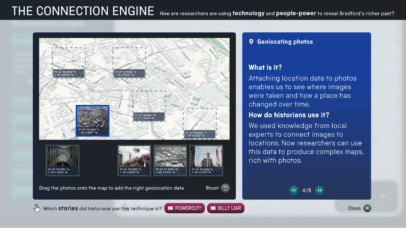
What is the Connection Engine? The Congruence Engine (later renamed Connection Engine) is a three-year research project funded by the Arts and Humanities Research Council in efforts to digitally connect industrial heritage collections across the UK. Using advanced digital tools such as AI, it links museum objects, archives, photographs, and more, enabling historians and curators...

Stamen at NACIS 2024

| 11.14.24

The North American Cartographic Information Society (NACIS) 2024 conference in Tacoma, WA was yet another fantastic gathering of cartographers, mappers, and map enthusiasts. Stamen was well-represented this year by Kelsey Taylor, Eric Brelsford, and Alan McConchie. This was a busy year for us – we presented five talks between the three of us! Now that...

Maps and visualizations we’re keeping an eye on for Election Day, Part 3: Down-ballot races and electoral math

| 11.01.24

Welcome to the third and final part of our series on maps and data visualizations in advance of the 2024 U.S. General Election (if you’re just catching up, here are parts one and two). Today, we’ll close with discussion of Congressional races and the electoral college. I’m just a bill We’ve mostly discussed the presidential...

Maps and visualizations we’re keeping an eye on for Election Day, Part 2: Indicators

| 10.31.24

Welcome to part two of our series on maps and data visualizations in advance of the 2024 U.S. General Election (if you missed it, here’s part one on polling). Today, we’re discussing other indicators of political outcomes, including money in politics, changing demographics, key issues, and previous elections. Here comes the money Politics is all...

Telling the Story of Changing Populations With Mapping Historical New York: A Digital Atlas

Content in this post comes from our presentation at the North American Cartographic Information Society (NACIS) 2024 Annual Meeting last week in Tacoma, WA. Mapping Historical New York: A Digital Atlas visualizes New York City’s transformations during the late-nineteenth and early-twentieth centuries both in terms of population and landscape. Drawing on 1850, 1880, 1910, and...